





FAQs for Isolator
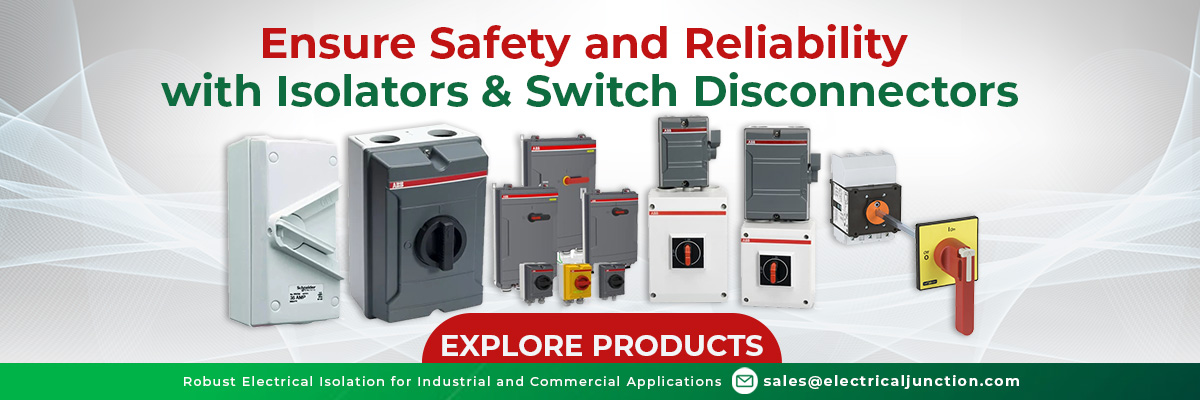
1. What is the difference between a Circuit Breaker and an Isolator Switch? It is a common point of confusion, but the distinction is vital for safety. A Circuit Breaker (like an MCB or MCCB) is an automatic protection device designed to trip during an overload or short circuit. An Isolator (or Switch Disconnector), however, is a manual device used to ensure a circuit is completely de-energized for maintenance. Unlike most breakers, an isolator provides a visible or guaranteed physical gap in the contacts and is designed to break the full rated load current safely. At Electrical Junction, we stock heavy-duty isolators from Schneider and ABB that are specifically designed to provide "positive contact indication," a mandatory safety requirement for industrial sites in the GCC.
2. Why is the IP65 or IP66 rating critical for isolators installed in the UAE and Saudi Arabia? In the Middle East, isolators are frequently mounted outdoors for AC units, rooftop solar arrays, or industrial fans. These units are exposed to fine desert dust and torrential seasonal rains. An IP65 or IP66 rating ensures the enclosure is "dust-tight" and protected against powerful water jets. We provide Schneider Vigi and ABB OT ranges that feature UV-stabilized polycarbonate enclosures, preventing the plastic from becoming brittle and cracking under the intense Arabian sun—a common failure point in lower-quality domestic alternatives.
3. Do your isolators comply with SASO standards for use in the Saudi Arabian market? Yes. All isolator switches supplied by Electrical Junction for the Saudi market meet SASO (Saudi Standards, Metrology and Quality Organization) requirements. We ensure that our switches are rated for the 60Hz frequency and the high ambient temperatures of the Kingdom. When you order for a project in Riyadh or Jeddah, we can assist with the SABER platform registration and provide the necessary Product Certificate of Conformity (PCoC), ensuring that your electrical switchgear passes inspection by the Saudi Electricity Company (SEC).
4. Can these isolator switches be used as a Main Switch for a distribution board or solar PV system? Yes, our range of switch disconnectors is commonly used as the "Main Incomer" for distribution boards or as DC/AC isolators in solar installations. For solar projects in Africa and the GCC, we provide specialized DC Isolators that can handle the high-voltage direct current (up to 1500V DC) produced by PV strings. It is critical to use a dedicated DC-rated isolator for solar, as standard AC isolators cannot safely extinguish the arc produced by DC current, which could lead to a fire.
5. Are your isolators "padlockable" in the OFF position for LOTO (Lockout-Tagout) procedures? Safety is our priority. Most of the industrial isolators we stock from Schneider and ABB feature handles that can be padlocked in the "OFF" position. This is an essential feature for B2B contractors and facility managers in the UAE and Africa to comply with international Lockout-Tagout (LOTO) safety protocols. By locking the isolator, maintenance teams can work on downstream machinery with the certainty that the power cannot be accidentally restored, meeting the strict HSE (Health, Safety, and Environment) standards of major industrial zones.