Currency


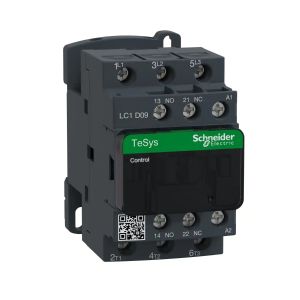
LC1D09M7 Schneider electric contactor


The Schneider Electric LC1D09M7 is a 9 A, 3-pole TeSys D (Deca) contactor with a 220 V AC 50/60 Hz control coil, used to switch three-phase motors up to 4 kW at 400 V. This guide covers the three things buyers most often get wrong or need to check before ordering: what the "M7" suffix actually means, how to wire the contactor into a direct-on-line (DOL) motor starter, and how to pick the matching TeSys LRD overload relay. If you are sourcing in the UAE, you can compare this model against our full TeSys and ABB contactor range before you order.
What the "M7" in LC1D09M7 means
The M7 in LC1D09M7 is the coil voltage code: it means the contactor has a 220 V AC 50/60 Hz control coil. The full part number breaks down as LC1D (TeSys D contactor body) + 09 (9 A AC-3 rating) + M7 (coil voltage code). The last digit of the coil code is the frequency: 5 = 50 Hz, 6 = 60 Hz, and 7 = 50/60 Hz.
If you order the wrong coil code, the contactor will not pull in on your control voltage. These are the common AC coil codes for the TeSys D range (LC1D09 to LC1D150):
| Coil voltage (AC 50/60 Hz) | Code | Example part number |
|---|---|---|
| 24 V AC | B7 | LC1D09B7 |
| 48 V AC | E7 | LC1D09E7 |
| 110 V AC | F7 | LC1D09F7 |
| 120 V AC | G7 | LC1D09G7 |
| 220 V AC | M7 | LC1D09M7 |
| 230 V AC | P7 | LC1D09P7 |
| 240 V AC | U7 | LC1D09U7 |
| 380 V AC | Q7 | LC1D09Q7 |
| 400 V AC | V7 | LC1D09V7 |
| 415 V AC | N7 | LC1D09N7 |
| 440 V AC | R7 | LC1D09R7 |
For a DC control coil, the code ends in D instead of a number, for example BD (24 V DC), ED (48 V DC), FD (110 V DC) or MD (220 V DC). So the 24 V DC equivalent of the LC1D09M7 is the LC1D09BD.
Terminal type is set by a digit inserted before the coil code: add 3 for spring terminals and 6 for fast-on lug terminals. For example, LC1D096M7 is the fast-on lug version of the standard screw-clamp LC1D09M7. If you need help matching the exact coil and terminal variant, our engineer can confirm the right reference against your panel drawing before you order the LC1D09M7 contactor.
How to wire the LC1D09M7 in a DOL starter
Safety first: isolate and lock off the supply before wiring, and confirm dead with a tester. A contactor coil and power terminals can carry lethal voltage.
In a standard direct-on-line motor starter the LC1D09M7 is wired as follows:
- Power circuit: incoming three-phase supply L1, L2, L3 lands on the top power terminals 1, 3, 5; the motor connects to the bottom power terminals 2, 4, 6.
- Control coil: terminals A1 and A2 take the 220 V AC control supply, switched through the start and stop pushbuttons and the overload relay normally-closed contact (95-96).
- Hold-in (seal-in): the built-in normally-open auxiliary contact 13-14 is wired in parallel with the start button so the starter stays energised after the button is released.
- Interlock or signalling: the built-in normally-closed auxiliary contact 21-22 is available for interlocking or an indicator lamp.
The LC1D09M7 ships with 1 NO + 1 NC auxiliary contacts built in, so a basic DOL starter needs no add-on auxiliary block. If you need more contacts, add a LADN-series auxiliary block on top.
Choosing the right overload relay for the LC1D09M7
The LC1D09M7 mounts directly onto a TeSys LRD thermal overload relay to form a complete motor starter. Size the relay to your motor's full-load current (FLA) from the motor nameplate, not to the contactor rating. Set the relay dial to the measured or nameplate FLA once installed.
Common LRD ranges that pair with a 9 A contactor, depending on motor size:
| Overload relay | Setting range | Typical motor (400 V, 3-phase) |
|---|---|---|
| LRD07 | 1.6 to 2.5 A | around 0.75 kW |
| LRD08 | 2.5 to 4 A | around 1.1 to 1.5 kW |
| LRD10 | 4 to 6 A | around 2.2 kW |
| LRD12 | 5.5 to 8 A | around 3 kW |
| LRD14 | 7 to 10 A | around 4 kW |
Always confirm the relay against the actual motor nameplate current. If you would rather have it sized and supplied ready to fit, our engineer can pair the correct LRD relay with your contactor: check live stock on the LC1D09M7 product page and send your motor details with the enquiry.
When to size up from the LC1D09M7
The 09 in the part number is the 9 A AC-3 rating, which suits three-phase motors up to about 4 kW at 400 V. If your motor's full-load current is higher, step up within the same TeSys D range: LC1D12 (12 A), LC1D18 (18 A), LC1D25 (25 A) or LC1D32 (32 A). The wiring, coil codes and overload-relay pairing all follow the same logic across the range, so only the current rating changes.
Frequently asked questions
What does the M7 in the LC1D09M7 mean?
The M7 in the LC1D09M7 is the coil voltage code, and it means the contactor has a 220 V AC 50/60 Hz control coil.
Can I change the coil on an LC1D09M7?
Yes. TeSys D coils are field-replaceable using the matching LX1D replacement coil, so the contactor can be converted to a different control voltage. In most cases it is simpler to order the contactor with the coil code you need, such as LC1D09BD for 24 V DC.
What size motor can the LC1D09M7 control?
The LC1D09M7 controls three-phase motors up to 4 kW at 400 V or 2.2 kW at 230 V under AC-3 (motor) duty, and switches up to 25 A under AC-1 (resistive) duty.
Does the LC1D09M7 include auxiliary contacts?
Yes. The LC1D09M7 has 1 normally-open and 1 normally-closed auxiliary contact built in as standard, which is enough for a basic DOL starter seal-in and interlock.
Where to buy the LC1D09M7
Need this contactor for a project? Check live stock, current pricing and bulk or export quotes on our Schneider LC1D09M7 product page, where our engineer can also confirm the coil voltage and overload relay for your application before dispatch.
February 25, 2023
|
View: 1087
|
Categories: Contactors, Electrical Distributor
|
Tags: Electrical control panels, Magnetic Contactors
|
By: Mohammad Afzal Siddiqui
About the Author

Related Products




Counterfeit Schneider and ABB MCCBs
August 8, 2026